
Team finance
A robotics team is a small organisation with real money moving through it, and most of them run it out of one person’s inbox. Robolyst gives that money a ledger, so the handover at the end of the season is a login rather than an archaeology project.
Free for every team · run by a 501(c)(3)
A parts request from the moment a student files it to the receipt on the ledger.
- Compliant wheels, 3in ×8 @ $7.68 $61.44
- Hex shaft, 8mm × 200mm ×4 @ $5.10 $20.40
- Axial bearing block ×2 @ $3.95 $7.90
Receipts are served through the app, so a receipt link cannot be guessed or shared out of the team.
On screen
The page itself, captured out of the live demo, which anyone can open, without an account.
Open it yourself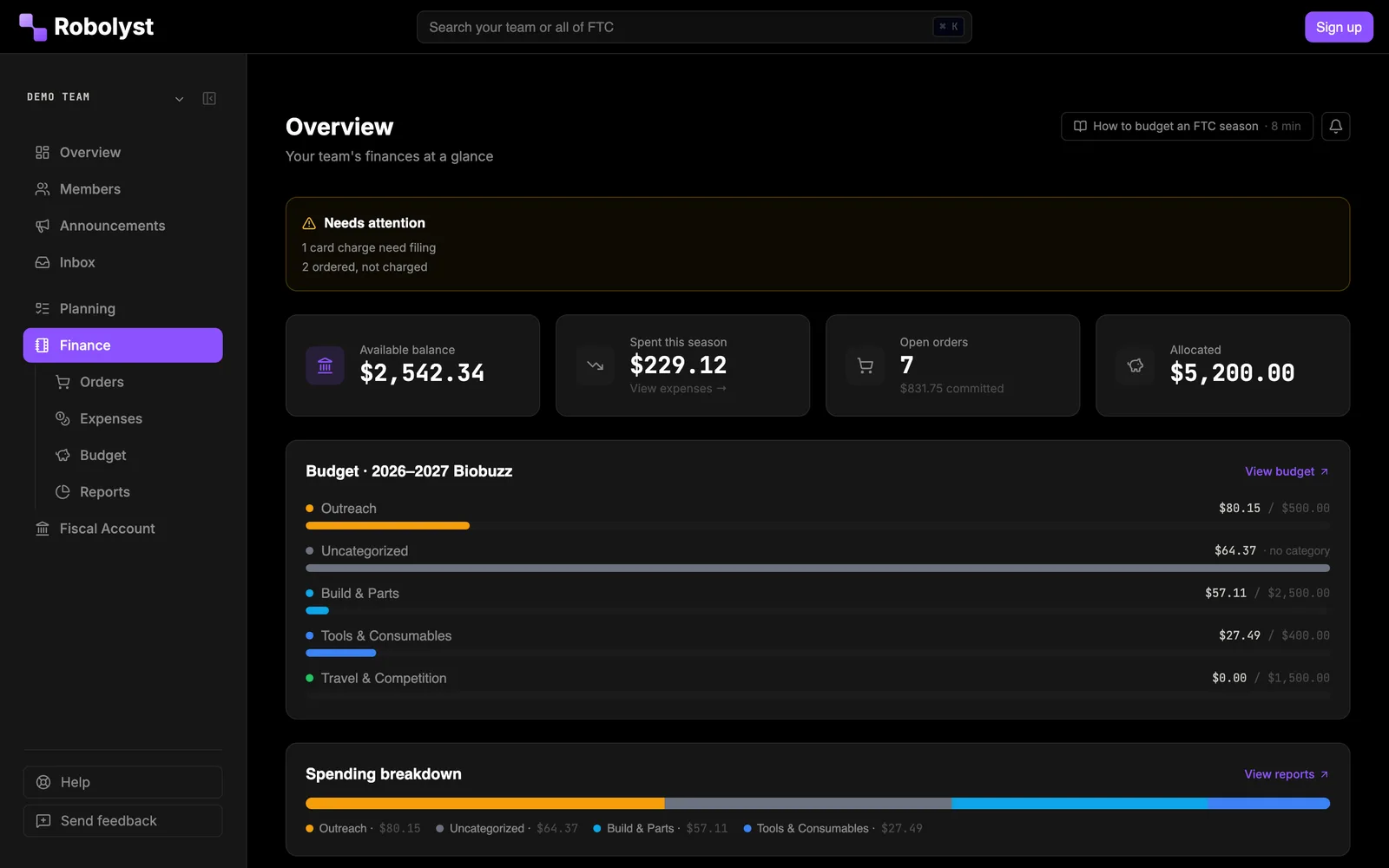
A budget that reflects the season
Set category budgets for the season and watch them against what has actually been committed, not just what has cleared. An order placed today counts against the budget today.
Orders, items and vendors
Track what was ordered, from whom, for how much, and which subsystem it was for. Per-item costs mean the drivetrain’s real spend is a number you can look up rather than estimate.
Expenses and reimbursements
Mentors and students submit what they paid out of pocket with the receipt attached, and see where the request stands. Receipts are served through the app rather than a public bucket, so a receipt link cannot be guessed.
The rules are yours to set
Every team runs its money differently, and the argument about who is allowed to spend what belongs in a settings page rather than in a group chat at 11pm. Write your policy down once and the portal enforces it.
- Auto-approve requests under an amount you choose, and route everything above it for approval
- Require a budget category, a product link or part number, and a needed-by date on every item
- Decide what happens when an approval would take a category over budget: block it, warn, or allow
- Require the invoice before an order can be marked placed
- Restrict purchasing to an approved vendor list
- Set who may log an expense at all, when a receipt is mandatory, and the figure above which a manager has to sign off
Cards students can actually use
A fiscally sponsored team can put a card in a student’s hands without handing over the account. Each card carries its own pot: an amount, an expiry, and the merchants it will work at. Spending is checked at the swipe, and what is left goes back when the card is handed in.
- Approve a purchase and the money is loaded onto that person’s card for that purchase
- Grants expire, so a card left in a toolbox in March is not a card with a balance in June
- Every transaction lands on the same ledger the budget page reads
- Reimbursements run the same approval path, and an address given for a cheque is visible only to the person cutting it
Donations and fiscal sponsorship
Take donations through a hosted page, issue receipts automatically, and, for teams that need one, operate under the Robotics Catalyst Foundation’s 501(c)(3) so sponsors can deduct their gift.
- A donation page per team, with an embeddable version for your own site
- Employer matching handled, so a sponsor’s company gift is chased and recorded
- Year-end donor statements generated from the ledger
- Applied for and signed inside the portal, countersigned by the foundation
- Your agreement, determination letter and tax filings kept on one documents page
Show the money, or don’t
A team that wants to publish its ledger can. The public version prints what was bought and what it cost, and never a name: no cardholder, no donor, no notes. Sponsors asking where the money went get an answer without anyone assembling a report.
Reports that survive the handover
A season chart that traces income through funds into spending, exports for every table on the page, and a ledger CSV your school’s finance office will accept. Hand the login to next year’s treasurer and skip the conversation where nobody can say what the team spent on the robot.
Questions teams ask
- Do we need to be a nonprofit to use this?
- No. The finance tools work for any team, whether the money sits in a school account, a parent booster club or a 501(c)(3). Fiscal sponsorship is optional and applied for separately.
- Can students see the budget?
- As much of it as you want them to. Seeing the finance pages and seeing the amounts on them are two separate permissions, so a build lead can read an order’s vendor, part numbers and status with every price blanked. Being allowed to see everyone else’s orders is a third. Reimbursements stay with the people who handle them.
- Who approves an order?
- Whoever holds the permission, and never the person who asked. A request goes to someone else on the team by default. On a team where only one person can approve, that person can approve their own, and the ledger records that it happened that way.
- Do we need a card to use this?
- No. Cards come with fiscal sponsorship, and everything above them works on any team’s money, whether it sits in a school account, a booster club or a shoebox. Teams tracking spend against budgets can turn income and balance tracking off entirely.
- What does it cost?
- The toolkit is free for teams. Fiscal sponsorship has its own terms, described during the application.
Read next
The rest of the toolkit
Team finance is one part of the portal.
The roster, the build schedule, your documentation, the money and your public site run on the same free account. Setting it up takes an afternoon.